 पेंशनर्स कॉर्नर
 स्क्रीन रीडर एक्सेस
 मुख्य सामग्री पर जाएं




हम जिस हवा में सांस लेते हैं उसे साफ करना: सीएसआईआर-आईआईटीआर द्वारा मल्टीपल-एटीएमओएस सफलता
Picture a mobile air-washing station that rolls into polluted streets and begins scrubbing the air clean. That vision now exists in the form of CSIR–IITR’s MultiPLE-ATMoS device.
Imagine a machine that can be wheeled into a polluted street and begin cleaning the air around it, removing dust, toxic gases, heavy metals, and even harmful microbes. A device that acts like a mobile “air-washing station,” giving cities battling smog a breath of relief. This vision is becoming real through Multi-Pollutant Legerity Effective Air Treatment Movable System (MultiPLE-ATMoS), a new air-purification system developed by scientists at the CSIR–Indian Institute of Toxicology Research (CSIR–IITR), Lucknow. Unveiled at the EARTH conference, this homegrown innovation promises to reduce some of the most dangerous urban pollutants and make India’s fight against air pollution smarter and more effective.
How MultiPLE-ATMOS Cleans the Air
At its core, MultiPLE-ATMoS works by combining multiple purification technologies inside a single compact system. The machine uses mechanical separation to capture fine dust like PM2.5 and PM10, photocatalytic oxidation to break down toxic chemical pollutants, and a wet scrubber to absorb harmful gases such as nitrogen dioxide, sulphur compounds, and carbon monoxide. The system tackles everything from tiny particulate matter to heavy metals, including lead, arsenic, and nickel, and even airborne pathogens that pose health risks. During field trials, the prototype demonstrated a remarkable 83–94% reduction in pollutants, treating nearly 1,000 cubic metres of air every hour, all while operating on a budget-friendly build cost of just ₹5 lakh (which will drastically be come-down when it is developed at a large scale).
Built for India’s Pollution Hotspots
What makes MultiPLE-ATMoS particularly valuable is its mobility and adaptability. Mounted on a sturdy four-wheel trolley, it can be transported to traffic junctions, industrial areas, construction sites, or densely populated urban pockets, locations where pollution tends to spike. Unlike stationary air-purification towers, this device can be positioned precisely where the pollution load is highest. Once the treatment is complete, the system’s by-products are environmentally safe and recyclable; one of them, gypsum, can be reused in construction and industrial applications, ensuring that the cleaning process itself leaves no harmful traces.
Is This Technology New to the World?
Globally, experiments with outdoor air-cleaning systems exist, but they are often large, expensive, and limited in effectiveness. What makes MultiPLE-ATMoS stand out is its multi-process integration in a low-cost, portable system — something not commonly seen in international prototypes. While wet scrubbers and photocatalysis are known technologies, combining them into a compact mobile platform designed specifically for urban smog control is a distinctive Indian innovation. Most global solutions focus on either particulate removal or gaseous pollutants; MultiPLE-ATMOS addresses both, along with heavy metals and pathogens.
A First for India’s Pollution-Fighting Toolkit
In India, large outdoor purification systems have usually been imported, expensive, or limited to experimental deployments in a few cities. CSIR–IITR’s system marks one of the first fully indigenous, mobile, multi-contaminant air-cleaning devices developed by a national scientific institution. Earlier efforts mostly relied on filter-based towers or single-technology systems, whereas MultiPLE-ATMS brings an integrated scientific approach designed around Indian pollution profiles, especially smog conditions dominated by dust, vehicular emissions, industrial gases, and construction debris.
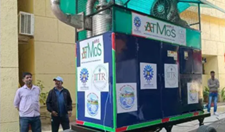
MultiPLE-ATMoS
Impact Beyond the Laboratory
The potential applications of MultiPLE-ATMoS extend far beyond initial trials. City administrations can deploy fleets of these units at choke points during high-smog periods, industrial zones can use them to reduce local air contamination, and construction sites can operate them to comply with environmental norms. The device also opens new opportunities for low-cost air-quality management in Tier-II and Tier-III cities that lack access to sophisticated pollution-control infrastructure. Its low build cost encourages domestic manufacturing, supporting India’s environmental technologies market while ensuring that clean air solutions remain accessible and scalable.
Breathing Towards a Cleaner Tomorrow
MultiPLE-ATMoS represents more than a piece of equipment, it signals a new way of thinking about air purification. Instead of relying solely on long-term policy measures or massive fixed installations, CSIR–IITR has created a nimble, science-driven solution that can respond quickly to the realities of Indian urban pollution. By transforming proven scientific principles into a mobile, practical device, the institute has taken a significant step toward cleaner cities and healthier citizens. It is a quiet, hopeful innovation, one that doesn’t just measure air quality but actively improves it, offering a clearer horizon for the India of tomorrow.
Vaijayanthi Sambath Kumar
Research Intern, CSIR